

Meeting 2, Jan 5th 2026
Pinning down some essentials of the CICM Board and Council
Notes and reflections from Meeting 2
Summary - this was a great meeting. Everyone was there, and it was very positive and constructive. I think we have really moved on. Thank you very much for all your hard work.
The notes are below - as always, please feel very warmly invited to send corrections and additions.
What will replace Exec?The TFG supported the concept of a "Triage Group", noting that there might be better names - maybe something like Support Group? Admin Group? Check-in group? Keep-in-touch Group? And perhaps calling it a meeting or function, rather than a group.
This would be what replaced the current Exec.
Lower down this page, there is an updated version of the diagram showing where it sits, and its proposed functions and membership. As agreed, I have removed the reference to inviting other people and people attending if they are interested.
The TFG felt that this group could be a very positive way of making sure that College business carried on between Council and Trustee meetings while maintaining transparency in general, and clarity of roles in particular.
A quick thought about terms of officeWe noted that a common (and probably sensible) term of office for Council Members, Trustees and Committee Chairs alike is three years. A person is usually eligible to stand for a second term as a Council Member or Trustee. Extensions to terms are usually granted in situations like the following: an elected Member of Council has served for two years and successfully stands to be a Trustee. In that case, they would get a three-year extension to their Council term to enable them to serve a full Trustee term.
This is fiendishly complex, and we'll need to do a lot more work here.
Who should be on Council and how should they get there?
I have updated the proposal - scroll down to see how I have attempted to summarise our discussions. We noted that Council could evolve over the next few years: it doesn't have to be irrevocably agreed by July. We could put minimum "standards" in the Articles eg "at least X people in Y roles elected by the Membership", and then the Articles could refer to the Regulations for further detail, particularly on co-opted or ex officio roles. It will be much easier to amend the Regulations than it will be to amend the Articles, particularly when CICM moves to the stage where members transfer from the RCoA and other bodies to CICM.
We also noted that Education is highly likely to move out of TAQ and become a main policy Committee, ie one which plays a substantial part in furthering the charitable purposes in its own right. Members of the TFG were supportive of this.
We talked about keeping Council a manageable size. We have already noted in previous meetings that Council can be much bigger than the Trustees, as it does not have to make decisions about topics that require detailed discussions in smaller group, eg tax, finance, HR, compliance etc. It is also right that Council is the place for many voices, to bring in expertise on all elements of the specialty. However, obviously it can't grow infinitely large...I suggest that anything under 30 is doing well, and our current proposals definitely meet that goal.
I welcome any and all feedback.
Board of Trustees, and in particular, Chairs of the main policy Committees
We are nearly there - at least, we are nearly there in terms narrowing down options, even if we don't have one single option that everyone is happy with. I think we are all agreed on the President, Vice-President, Lay Trustees and the possibility of Trustees recruited for a specific time period if particular skills were needed. So all that remains is "Who else from Council is on the Board?".
(note: we agreed that we did not want to recommend electing to the Trustees directly from the Membership, with successful candidates being Trustees
but not on Council. )
Mishcon de Reya's and my recommendation that Chairs of the main policy Committees should also be Trustees was based on an assumption that these Chairs would be elected by Council, and that those votes would be cast in the knowledge that the successful candidate would join the Board. As noted yesterday, I'm sorry that the election part of this wasn't clear enough in the pre-read: I thought it was something we all already had in our minds, but I was obviously wrong.
I also want to re-emphasise that there is very little consistency across medical Colleges here, especially as not all Colleges make it easy to see who does what, and there are often different job titles for similar roles. There definitely isn't a clear enough pattern across other Colleges to say "everyone else does this", which is why we haven't made any such statement - and anyway, even if there was a pattern, it is still your choice about what is best for CICM.
The advice from Chris and me is based partly on charity governance principles and charity law and partly on our view about what will be easiest and most pragmatic for a brand-new charity with limited staff resources: nothing else.
So, I think this probably comes down to two main options now, which are:
Option A
- Chairs are elected by elected Council Members, or chosen by a Nominations Committee after an open advert to all elected Council Members (up to FICM/CICM to decide which method - but please note that even a small Nominations Committee needs a few warm bodies from inside Council and/or will need people from outside Council - this in itself can be a sensitive choice, and means that with a small body of elected Members we might run out of unconflicted people!)
- These people are not automatically Trustees. There is no link at all between the roles. The College manages the risk and extra admin/resource needs this will create (set out below)
- The Chairs can apply to be Trustees, but their term as a Trustee is highly unlikely to line up with their term as a Chair, meaning that either their Council term is extended even longer or there is never a space on the Board.
- (Note: whichever option is chosen, the Trustees will be able to remove someone from their role as a Chair or as a Trustee if they are performing poorly. This could be at Council's request. )
- The Board of Trustees would be as follows:
President and VP
Three Lay Trustees
Four to eight Trustees who are elected Council Members, elected to the Board by elected Council Members
(If needed, up to three Trustees recruited for particular skills for a specific time period)
Total: 9 to 13 in steady state. This would be impressively small for a medical College.
Risks and admin / resource needs that will need to be managed
(please note that none of these are deal-breakers, but it is important to be aware of the downsides as well as the upsides.)
- The Chairs should be at Board meetings anyway, to advise Trustees, answer questions contribute to discussions - either there for the whole thing or called in and out where relevant. The first will create a risk that the Chairs will "accidentally" be charity trustees in law anyway, if they are deemed to meet the S177 definition in the Charities Act. The second feels like it would be disjointed and not a good use of the Chairs' time. It will also be harder to meet Charity Commission, Charity Governance Code and the new Charity SORP requirements for clear lines of accountability and decision-making.
- To meet Charity Governance Code requirements, each main Committee should include a Trustee - if this Trustee is not the Chair, the College will need to manage this awkwardness (ie for each main Committee, there will be a Trustee from the Committee who is not the Chair, and a Chair who is not a Trustee) at Board meetings and ensure that there are clear lines of communication and accountability
- If a Chair successfully also stands as a Trustee, their term of office without needing to go back to the Membership for an election will be extended for another three years, to enable them to do a full Trustee term. The minutes of Board meetings may need to be clear at all times whether the person is speaking in their role as a Chair or as a Trustee (I will check this).
- The Chairs will almost definitely need a regular meeting if they are not regularly all together at the Trustee meetings - this will then require ToRs, staff support etc. Again, the College will also need to be vigilant about the Chairs not slipping into S177 definition.
- This is a very nuanced point, but the College will also need to be careful about the balance between the best interests of the Charity (which should drive every decision) and the desire to help Council Members to feel fulfilled. There is definitely some overlap here, because an enjoyable Council will attract good people, but it would be advisable to be confident about justifying the extra risk and admin.
Reasons for Option A - the view of some members of the TFG is that this would be more democratic, and would offer opportunities to more Council Members, spreading the workload more evenly and bringing different skills to the Board. It would also remove the risk of losing a good candidate because they did not want to be a Trustee and a Chair.
NB I've said "some" because I thought I picked up at the end of the meeting that some people still weren't sure.
Option B
- Chairs are elected by elected Council Members after an open advert to all elected Council Members, setting out the skills and experience required. Candidates must provide a statement explaining how they meet these requirements. This will be made available to elected Members of Council, who will then vote. This could be on an STV basis, and would be online, not at a meeting. Council will be required, by its Terms of Reference, to vote in the best interests of the College and not on a popularity basis.
- These people will be automatically Trustees (ex officio Trustees), with a three year term covering both roles.
- (Note - as above, the Trustees will (as above) be able to remove someone from their role if they are performing poorly. This could be at Council's request.
- The Board would then be as set out below:
President and VP
Three Lay Trustees
Four Chairs (CRW, TAQ, PAS and probably Education), elected to these roles and also to the Board by elected Council Members
Four Trustees who are elected Council Members, elected to the Board by elected Council Members
(If needed, up to three Trustees recruited for particular skills for a particular time)
Total: 9 to 13 in steady state. As above, this would be impressively small for a medical College.
Reasons for Option B - these are set out below, and are unchanged since they were provided before the meeting.
Please let me know your final (or at least temporarily final) view on Option A or Option B or any other Option you think of - there is a Feedback link below.
Should the President of Council and the Chair of the Trustees be the same person?
We have agreement: yes, they should.
The reasons are set out below and are also unchanged.
What is the quorum for a Trustee meeting, and what constitutes a majority?
We have agreement: the TFG accepted the recommendations set out for the meeting
Next steps
- Lucy to write notes
- Members of the TFG to give feedback on the notes, and on the Chairs question
- Lucy to provide a summary to the Exec to ask for feedback - please note this is not asking for approval!
- Lucy to provide a similar summary to the FICM Board for the January 21 meeting
Thank you again for all your hard work.
UPDATED since Meeting 2 - Basic structure and Triage Group
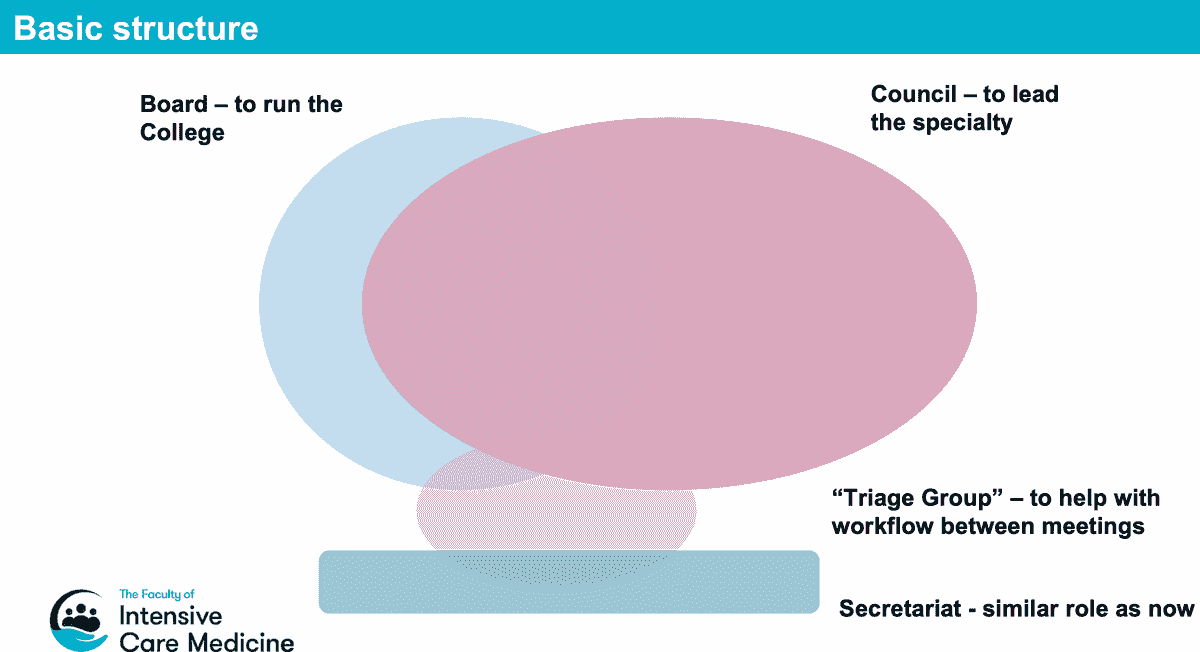
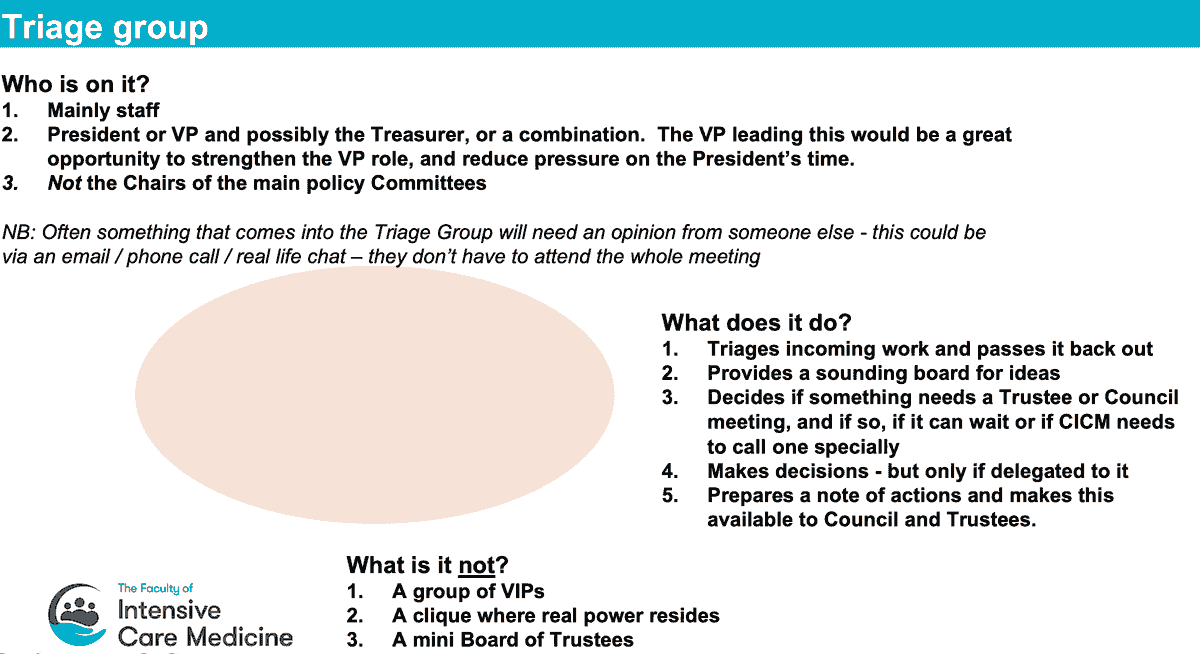
UPDATED since Meeting 2
CICM CouncilPurpose
Council will have oversight of all clinical, professional and health policy matters
Composition:
See belowUPDATED. Elected by
Members
12 consultants
Two resident doctors
One consultant to represent each of Scotland, Wales and Northern Ireland (ie three in total)
One SAS doctor
= 18 people, all consultants except the Resident and the SAS doctors.
At a later point, we can consider having more or fewer elected Members, depending on decisions about the Board of Trustees and main policy Committees.
The point of this is to keep the proportion of Council Members who are Trustees to Council Members who are not Trustees sensible - we don't want a situation where only a few elected Council Members are not Trustees, feeling left out - nor a situation where the Board of Trustees does not have a substantial majority of Council Members.
UPDATED Co-opted or ex officio
- NCCG (National Critical Care Group - the national representative body for doctors in training in Intensive Care Medicine) - is this OK?
- President of the ICS - is this OK now that we know it is not just England?
- ACCP (Advanced Critical Care Practitioners)
- PCCS (Paediatric Critical Care Society)
- Lay rep
- Defence
- Chair of LEPU if not already from the elected Council Members - also need to check if there is a route in already
- Chair of SSUAG (ditto) - but consider that they already feed in through another Committee
- Chair of Education - although note that there is a strong opinion forming that Education should be a Committee in its own right alongside TAQ, CRW and PAS and in this case, this person would be an elected Council Member
5 to 8 people
UPDATED No / Not now
- National Clinical Director for Critical and Perioperative Care - because this is England only, and because they will not be needed or be able to contribute to most items of most meetings.
- Critical Care Pharmacy - although the current representative is a great contributor, there are not enough pharmacist members to justify a place on Council
- CCLF (role insufficiently clear at the moment)
- Overseas rep (not enough overseas members at the moment)
- Nurses (not enough nurse members at the moment)
- RACs (no desire from the group to make this a specific category - of course, they are not barred from standing)
- Chair of FFICM - because they will feed in via TAQ
- Lead RA - because they feed in via another route
Elected by Members
(provided
before Mtg 2 )
- 12 elected Members of CICM Council "without portfolio"
- Two Resident doctors
- Scotland
- Wales
- Northern Ireland
- SAS doctor
= 17 people
Consider having some more elected Members, depending on decisions about the Board of Trustees?
Co-opted or ex officio
(provided
before Mtg 2 )
- Critical Care Pharmacy
- NCCG
- ACCP
- PCC
- Lay rep
- Defence
- Chair of LEPU if not already from the elected Council Members
- Chair of Education (ditto)
- Chair of SSUAG (ditto)
- Chair of FFICM (ditto)
6 to 11 people
No / Not now
(provided
before Mtg 2 )
- National Clinical Director for Critical and Perioperative Care (England only)
- President of the ICS (ditto)
- CCLF (role insufficiently clear)
- Overseas rep (not enough)
- Nurses (not enough)
- RACs (no desire from the group)
2. Possible composition of the CICM Board
In the meeting, we will look at its purpose, composition, Chair, quorum and majorities
We have already discussed the Board's purpose, and I think we have reached broad agreement.
Purpose
The Board of Trustees will have the general control and management of the administration of the College.
This is the definition from the Charities Act 2011.
As already discussed, in plainer English, I think we would say that the Trustees' responsibility is to further the College's charitable purposes. There will sometimes be a need to approve, question or challenge something that comes from Council (for example, if there are significant financial or reputational risks), and it will need to commission and approve the College's strategy. But its main agenda items will be based on holding staff (and others) to account for delivering the College's strategy, money, risk, governance and compliance, reputation, running the College, etc etc. It will also support Council if Council escalates something to the Board for their advice or agreement to resources. This is really important: it isn't a teacher marking homework! Council and the Board are both there for the same reason: to deliver the College's aims.
We won't be able to agree everything about the Board at our January meeting: we will work on the rest of the detailed arrangements in February 2026 - particularly term lengths.
For January, we will look at the composition of the Board of Trustee, who should be Chair, the quorum, and majorities.
Composition
I have split this into two halves:
For the first half:
where I think the TFG is at least relatively comfortable with proposals so far, and one where I think there is still
a debate to be had.
For the second half:
I have covered two options.
As mentioned above, I have also added notes with shared thoughts from Chris and me, following the training on December 12th.
First half:
Where I think the TFG is relatively comfortable
I think everyone is happy with this - but of course, please let me know if not.
President and Vice-PresidentThe President and Vice-President (noting that the VP should not automatically become the President)
These would be people elected to Council by the College's members, and then chosen for these roles by Council.
Council will have a duty to make this choice in the best interests of the College.
Lay Trustees
Three Lay Trustees have already been appointed
(Treasurer, Governance and Legal, and Communications)
In future, the Board will appoint these people, following a rigorous process with support from professional charity recruiters,
and in accordance with guidance set out by the Charity Commission and the Charity Governance Code.
Specific skill, specific time Trustees
(Co-opts )
There will be a power for the Board to co-opt/recruit up to three Trustees to fill a specific need for a specific time if this was not met by the current Trustees.
This is only a power, not a requirement.
The other half:
Where I think further discussion is needed
Option 1:(discussed at length, mixed feelings in the TFG)
Trustees who are elected from Council to be Trustees
- Three elected Members of Council, to be appointed by their peers to become Trustees.
- This could be anyone, whatever career stage they were at.
- Their function would be to provide challenge and different views to the other Trustees, who are likely to be further advanced in their careers and very networked.
- Council will have a duty to make this choice in the best interests of the College.
Chairs of the three main policy Committees
- The Chairs of PAS, TAQ and CRW - but not Audit, Risk, Investment or any smaller groupings.
- Again, these would be people elected to Council by the College's members, and then chosen for these roles by Council through a transparent process (definitely not chosen by a tap on the shoulder).
- Council will have a duty to make this choice in the best interests of the College.
Option 2:
(not discussed at such length, but it's the most obvious
alternative if there is no or little support for the first option)
Simply: four to eight members of Council
- Four to eight (TBD) elected Members of Council, to be appointed by their peers to become Trustees.
- This could be anyone, whatever career stage they were at.
- Council will have a duty to make this choice in the best interests of the College.
(NB Another possibility is electing to the Trustees directly from the Membership, with successful candidates being Trustees
but not on Council. We can discuss this if any of you think it would be good for the College)
Recommendation for the "discussion still needed" half of the Board
Our view is that the first option (the Chairs of the main Committees, balanced by "backbenchers") would work well for CICM.
We are mindful that opinions on the TFG are varied, and that there is some concern about the possibility of the Chairs being ex officio Trustees. We spoke at length about this after the training on Friday December 12th, so that we could set out our reasons as clearly as possible. Again, there is no law or regulation about this one way or another.
The reasons are based on the fact that the Chairs will lead the key Committees that deliver the College's charitable activities. So it is essential that there be good and clear communications between the Board and the Committees, and the Board of Trustees will need the Chairs' advice and knowledge to make good decisions and ultimately to discharge their duties to ensure that the College is delivering its charitable purposes for the public benefit.
The seven reasons below outline are our shared view about why we think that the first option is the most straightforward way to enable this.
Reason 1 - for good governance, the Chairs should be at BoT meetings and engaged with the BoT
Our view is that the best way to make this happen is that the Committee Chairs attend BOT meetings and engage in discussions as part of the Board of Trustees. This would mean the Committee Chairs being there for all the cross-cutting elements of the Board's work, rather than stepping in and out when their Committees are reporting back to the Board.
lt would be very odd if Committee Chairs weren't at the BoT at all, and we think it will be less effective if they were just parachuted in for one agenda item to give a short presentation and then asked to leave.
This is to ensure that the design of CICM's governance supports a close connection between the Board's wider agenda and the College's charitable work delivered through the Committees.
Reason 2 - this will bring clarity and minimise risk of liability
Given the need for Committee Chairs to be present and involved at the Board of Trustees, the question is whether they should be Trustees or only non-voting observers.
We think that, in practice, it would be hard to ensure that their influence is kept at the level of observers only, so we think the most straightforward option is to make them Trustees ex officio.
This is partly to ensure that there is a manageable number of people in the room, partly to ensure that those participating are doing so on a clear and equal footing, and partly to mitigate the risk of Chairs inadvertently taking on liability as 'shadow' or 'de facto' trustees/directors.
Reason 3 - these roles are not "tap on the shoulder" any more
We understand and sympathise with the concerns about how a person is made a Chair (ie the "old days" tap on the shoulder), but that is a separate point, and one where there is already a corresponding agreement to move to a more democratic way of choosing Chairs.
Reason 4: the idea that this is a short-cut to the Board does not align with the role of a Trustee
We also understand and sympathise with the concern that this might feel like a free ticket to the Board.
Our response here is that membership of the Board should not be seen as the most desirable destination in CICM, to which short-cuts are available only for special people.
Being on the Board is about giving back to the College, and taking responsibility for its mission and activities.
Reason 5: in most cases, we do not think Trusteeship puts people off Chair roles
We also understand and sympathise with the mirror image of the previous concern, that some people who would be good Committee Chairs might not want to be Trustees and therefore might not apply.
We acknowledge the possibility of losing good candidates because they do not wish to be Trustees, but we are not aware that this is a widespread problem in medical colleges. Nearly all medical college systems of governance include some level of ex officio positions on the Board of Trustees as a result of Council roles.
There may be some misunderstanding about the responsibilities and liabilities of the Trustee role, which could and should be addressed in the recruitment process for Chairs (and, indeed, other roles).
Reason 6: this option would not create a situation in which more than half of Council were Trustees
We agree that there should be enough elected Members of Council to ensure that those who are also Trustees are not a majority of Council.
This would be achieved if - as we have discussed already - the new structure included more elected Members of Council, to cover the devolved nations and whatever cohorts (eg recently appointed consultants) the FICM Board thought was appropriate to see represented on Council.
We have already noted that this would be a good idea.
Reason 7 - this option would enable clearer lines of accountability
Our final point is more pragmatic. It is standard for Committees in charities (including medical colleges) to include at least one
trustee, and it is part of the role of Committee Chairs, under the Charity Governance Code to ensure effective communication between Committees and Boards.Putting these two practices together, it is therefore also usual for key Committees to be chaired by Trustees (with non-Trustee chairs more common for Investment and Audit & Risk committees).
It is simple and clean if a Trustee is also the Chair: if not, the lines of accountability are likely to get confusing – for example, it may mean that the Chair of a Committee attends a Board of Trustees meeting for one item to present their Committee's
work, but the Board to whom they are presenting includes a Trustee who is a member (but not Chair) of the same Committee.3. Who should be Chair of the CICM Board?
There are two main options here.
Option 1: the Chair of the Board of Trustees and the President are the same person
Option 2: the Chair of the Board of Trustees is a separate Lay Trustee (ie not the President and not a member of Council)
Overall, we think it is right that they should be the same person, although we would like to emphasise again that this is a question of weighing up the pros and cons and deciding on an option that will work best for CICM as a charity and a medical college.
Again, we are mindful that opinions on the TFG are varied, and this is another topic we discussed at length after the training on Friday December 12th, so that we could set out our reasons as clearly as possible.
The six reasons below are Chris's and my shared view.
As always, please feel comfortable: there does not have to be one unanimous view from the TFG. Every member of the TFG is entitled to hold whatever opinions feels right to them.
Reason 1 - a Lay Chair will not solve the problem of the "rogue President" or the "rogue CEO"
There seems to be a fear of the President being autocratic, or not strong enough, or not being neutral. In this case, there is a concern that this will be magnified if they hold both roles.
Our view here is that the remedy for this situation lies in the Trustees' legal duty to act collectively in the best interests of the College. This duty applies to the President in their trustee role, but the other Trustees should also act if they feel that the President is exercising more power than he or she is entitled to, and they should also act if they feel that the President is not acting in the best interests of the College, eg favouring a view or course of action that creates a conflict of interest or loyalty. It shouldn't be left to one person, the Lay Chair, to deal with the problem.
While we acknowledge this concern, we do not think – on reflection – that designing a governance structure with a Lay Chair to guard against the risk of a President "going rogue" is the right solution to the risk. There is no guarantee that that Lay Chair will be able to stand up to the President - and moreover, there is no guarantee that the Lay Chair, or the relationship between the Lay Chair and President, will not be the cause of a power dynamic problem in the first place.
There are other ways to put guardrails around the President role, including how the functions and powers of the role are defined in the College's governing documents and the role description (particularly as compared with other possible roles, such as Vice President, Treasurer, Committee Chairs), as well as training.
Update - please note that this is not intended to imply that the Trustees should just leave a "rogue President" in place. A proposal we have already agreed is that the Trustees would have the power to remove one of their own, and in a situation this serious, we would expect that they would consider this. (They might want to take legal advice, as it would be a big step. Usually, just the suggestion is enough to be a catalyst for better behaviour).
Reason 2 - a Lay Chair is not the best solution to the workload problem
We acknowledge the possible workload issue, but this is not an unusual situation for a President of a medical college, and we think the people standing for this role will be aware of what is expected, particularly if this is made clear in the role specification.
And the important thing is that the new CICM Board and Council work together to share the tasks, supported by the staff available to CICM, not letting everything fall to the President. Spreading the workload in this way should also help with mitigating the risk of the President exercising too much authority, as they will be operating within a structure and team.
Reason 3 - the skills required for both roles are not that different
We also note your concern that Council will focus on the profession and the speciality, and that the Trustees will need a wider focus, covering the speciality and also including finance, risk, compliance, and so on.
However, a Chair does not need to be an expert in the subject matter of the discussion: they simply need to make sure that they have absorbed the papers, asking questions in advance where necessary, and can lead the meeting with authority.
The skills for chairing a Trustee meeting will be very similar to those required for chairing Council: the ability to manage more vocal people's contributions, check that quieter people are being heard, summarise discussions at various points and then bring the conversation to a conclusion.
There is a wealth of training opportunities for Trustees and also for the Chair role: they are not expected to arrive with all the skills they need on day one.
Reason 4: as representative of the College, this person should be an intensive care doctor
Moving onto more positive points, we think that it is right for the Chair of the Trustees to be an intensive care doctor. They will sometimes be the face or voice of the College for extremely important issues, for example if there were a legal or regulatory issue, or if there is a controversial decision around spending, eg buying or selling property, updating member fees, etc.
More benignly, theirs will be the signature on the Trustees' Annual Report and financial statements, and the Chair is the person who would lead on presenting the Trustees' Annual Report at the AGM and chairing the whole meeting.
The decision has already been made that the Treasurer will not be an intensive care doctor, and our view is that it would be strange if this was also the case for the Chair of Trustees.
Having the Chair as an intensivist, supported by and balanced with a lay Treasurer, feels like the right balance rather than two lay people at the top of the new College.
Reason 5: benefit to the NHS
Developing people's skills within the NHS is also a positive reason. We usually find that people say they learn and develop a huge amount in leadership roles in College governance, and if the Chair of Trustees is a doctor, the skills they learn will benefit the NHS during and after their tenure.
Reason 6: this is an opportunity for simplicity in what will be a newly complex environment
For the final reason, some context first. Of 18 Royal Medical Colleges that we have looked at over the last few days, 13 have the same person in these two roles. Of the five that don't, one is the Royal College of Physicians of London. As you are all aware, the RCPL has gone through a huge governance upheaval over the last few years, including criticism that the Board of Trustees was not sufficiently close to the membership. One of the others is the Royal College of GPs, whose tripartite model we would definitely not recommend to you (they have a Chair of Council, President AND Chair of Trustees).
CICM will be a brand new College and charitable legal entity, and this change will be challenging enough on its own. Deciding who should Chair the Trustees is a decision where you can avoid complexity and choose to keep things simple for the next few years while you settle in, and follow a tried and tested method that works for the majority of Royal Medical Colleges.
4. The BoT quorum, and what constitutes a majority
The quorum for the BoT
The quorum for a Board of Trustees meeting is the minimum number of unconflicted trustees required to be present in order for decisions to be validly taken.
To be clear - it is not a goal! Trustees should attend meetings: the quorum is only a safety net.
This is really up to the FICM Board - you will need to balance two concepts:
- what is the minimum number of Trustees that would enable you to feel comfortable with them making decisions?
- what is the maximum number of Trustees that doesn't make it too hard to be quorate?
A nice straightforward (and tried and tested!) quorum is:
"50% of the Trustees, which must include at least one person from each of the following two categories:
- the President and the Vice-President
- the Lay Trustees"
Please note that a Trustee with a conflict cannot be considered part of the quorum for that agenda item. This can sometimes require the Secretariat to be alert, and to keep counting throughout a meeting.
What constitutes a majority for a Trustee resolution?
This is usually very simple, just "anything over 50% of the Trustees who are entitled to vote" (ie Trustees who are not conflicted).It is absolutely standard for the Chair of the meeting to have a casting vote. In practice, this is very rarely used (and I have literally never seen it happen myself): most Chairs will work very hard to achieve a majority rather than using their casting vote.
We do not recommend giving anyone (or any group within the Board) a veto - this would give them too much power.
A couple of you said that in the case of the Trustees voting to remove a Trustee, you thought there should be a higher majority required. This is possible: I just have two concerns. The first is that the will of the majority of the Board could be thwarted by a small number of supporters of the Trustee in question.
The second is that this might seem like saying to the College's members: "we only need half of us plus one to completely change the exam system (for example) but we are going to have a higher standard for removing one of our own". You know your members better than I do, so just let me know.
Feedback on Meeting 2
Please tell me anything you want - especially your final / near final / latest thoughts on who should be on the Board of Trustees.
Purpose of meeting 2
(old text from the pre-reading)
After this meeting and its follow-up, we should be able to update the FICM Board on the group's ideas about CICM Board and Council essentials.
Ideally, we will cover:
- Purpose and composition: Who is on Council and how do they get there? (this will iterate with decisions about the Board of Trustees)
- Board of Trustees: Who is on the board and how do they get there?
- Who is the Chair of the Board of Trustees?
- What is the quorum for a Trustee meeting, and what constitutes a majority?
- Next steps
Context for the meeting
This group is tasked with identifying recommendations for CICM's governance design.
The group does not have to agree unanimously on what to present. Ideally, we would minimise the number of options for the FICM Board, to make their decisions easier in April. But (assuming that some level of compromise over the finer points of detail is possible) no-one on the group has to pretend that they support something with which they are unhappy.
After the training on Friday December 12th, Chris Willis Pickup (the charity partner from Mishcon de Reya who is advising the RCoA on FICM's transition to CICM) and I reflected and discussed further, so that we could come back to the TFG with pros and cons and our shared view on two particularly important topics. These are the composition of the Board, and who should chair it.
Apart from these two topics, I have simply set out what is standard practice, or asked your opinion. The feedback mechanism is slightly different this time: it's not a Google doc; it's just a webform. I welcome feedback on how to give feedback...


Website created by Wellspring Consulting for the CICM.