

Meeting 3, Jan 28th 2026
The driest one yet...
Eligibility and electorates
Summary of Meeting 3
MEETING 3 MATERIALS
Introduction
In this meeting, we will try to pin down who can stand for what role, and who can vote for whom. This will be dry and technical (sorry!) but I think and hope it's the last big push.
If possible, I would also like to talk about how to get to the April Board Meeting and get enough agreed at that meeting to enable Independence Day in July. I think we need to keep in touch with the Board as a whole over the next few months, and keep testing opinions. That way, we could narrow down some choices, so that the April Board meeting isn't too complex.
Finally, I have written down a few notes at the end about feedback on the proposals that came out in the Board meeting, and welcome your thoughts on this.
Onto the detail!
Eligibility - what is it?There are different ways to consider eligibility, which we'll need to think about in the round. These are:
- Characteristics of the person - eg their level in the NHS, or the cohort they are in, or where they are based
- The length of time the person has served already
Electorates
Here, we will need to work out a balance between democracy and pragmatism! The College will be dependent on its CRM (Customer Relationship Management) System to generate lists to send to the election provider to enable voting. So complex sub-divisions of the Membership to create mini-electorates may not be possible.
We should also think - is it ever likely that there will be so many candidates for Council that we should provide a power to create a Selection Committee to create a shortlist?
What I've set out for us to consider
I've tried to get the right compromise between giving you a genuine and manageable choice of workable options, and exhausting your patience by presenting too many slightly similar variants. Please just let me know, though, if you think of another twist on something I've suggested that could end up being the winner.
Assumptions I've made
- That the basic building block of a term on Council is three years or four years (I think five would be too long, especially with the possibility of a second five year term).
- That the minimum time on the Board of Trustees is three years - and that it's OK if a term on the Board of Trustees is three years even if Council is four years
- That a Chair term, the VP term, the President term, and the Elected Council Member Trustee are all the same length, whether that is three years or four years. NB this has implications for the Resident Doctor terms - more detail follows.
- That the President and the VP do not have to go up for re-election every year. And to complement this: 1) as already agreed, the VP does not automatically become President 2) as also already agreed, there will be a power for the Trustees to remove one of their number, so if the President is not performing, they could be removed at any time - you wouldn't have to wait until official election sesason.
- That an Elected Council Member serves their first term and is eligible to stand for a second term, after which they must take a break of a year until before being voted in and starting another term on Council - unless any of the extensions I've set out below apply. We could also consider "4 years plus 2 years". This might address concerns about how long it takes to settle in and be productive, while maintaining turnover and freshness.
- That in exceptional circumstances, which must be recorded at the time, the Board of Trustees may vote to extend an individual's term on the Board or on Council by a year. (eg to finish an important project, or because no-one can be persuaded to stand to replace them)
Resident Doctors
UPDATE - I think I had misunderstood how Residents are elected when I wrote the sentence below -
"At the moment, the Board term for a Resident Doctor is dependent on their time as Deputy Chair and then Chair of the IiT Sub-Committee. "
but I do still think we need to discuss how long a Resident Doctor's term is, so I think the next three sentences still stand.
"However, this means that it is very short, at just two years.
Does this still feel right, especially if Council is to make more decisions in future? The same argument about needing time to settle in and do a good job on Council seems to apply to Resident Doctors as much as other members of Council. "
And finally, it's important to remember ....
Council is both the starting point and the anchor.
Apart from the Lay Trustees (and possible co-opts), everyone who is on the Board of Trustees is only there because the Membership has already voted them onto Council.
This will be particularly relevant in the situation where someone has already served a chunk of time on Council or the Board stands for a role which would result in yet another extension of their Council term. Assuming that the FICM Board agrees that the President, VP and Chair roles all depend on a Council election, Council will have the power to say either "You're great, but it's time for someone else to have a go" or "You're great, and so we will extend your time on Council without you having to go back to the Membership for a new mandate".
1
Suggestion to discuss: electorates for each Council role
I haven't done a similar table for the Board of Trustees, as the electorate will be just "the elected Council Members"
Role
Electorate
Comment
Elected Council Member
(not Devolved nation)
All Members with voting rights at an AGM
Includes Resident Doctors,
ie Resident Doctors can vote for all Council posts, not just the IiT sub-Committee elections
We are waiting for the Membership TFG to determine proposals for the rights, privileges, fees and obligations for each class of Member - this will identify who can vote for what and when.
Elected Council Member
(Devolved nation)
As above, but only if the home address has a postcode in the devolved nation
(NB Members don't have to give their work address to the College, which is why I've specified home address)
As above - and we also need to check what is possible in terms of the College's CRM system
Resident Doctor
UPDATE
Please see above in the introduction - I think I have got what I wrote below wrong, and I will try to sort it out.
"This will be determined by the IiT sub-Committee rules and voting system."
SAS / other cohort
To be discussed - it may not be possible to reliably identify an electoral cohort via the CRM system, so the electorate might have to be all the Membership
2
Suggestions to discuss: "person-based" eligibility for each Council role
Role
Eligibility
Comment
Elected Council Member
(not Devolved nation)
Consultant
(NB a person from a devolved nation is not restricted to standing only for the "devolved nation" role)
Is this right? Or should anyone be able to stand, eg Resident, ACCP, SAS, even if there is a separate category already "reserved" for that cohort?
Elected Council Member
(Devolved nation)
Consultant working in a hospital in the devolved nation, or with a contract to start work in the devolved nation in the first year of the Council term.
I think that this person needs to be a consultant, to have the required experience of NHS Scotland/Wales/NI and other factors which are special to that devolved nation.
Separately, I suggest that if this person then moves away from the devolved nation during their term, they could carry on until the end of the College year in which they move - but at that point, they shouldn't be the representative for the devolved nation any more.
Resident Doctor
UPDATE
Sorry - when I said the following:
"This will be determined by the IiT sub-Committee rules and voting system" I had misunderstood.
I am trying to get hold of Tacqua so that I can get on top of this!
SAS / other cohort
Able to demonstrate to the College Secretariat that they are in this cohort (whatever the cohort is)
Although I noted above that it might not be possible for the CRM to identify the whole cohort in order to generate a list for voting purposes, it should be straightforward for the Secretariat to determine whether or not a few people meet the definition.
Question - who is eligible to be a Trustee?
We have already agreed not to have any reserved spaces on the Board of Trustees for particular cohorts.
However, this still leaves a question:
Should any elected Council Members not be eligible for the Board of Trustees?
(My view is that this is entirely up to you and the FICM Board, and we can begin the discussions on Wednesday)
Time-served eligibility: how long is too long?
This can be very tricky, as it requires a balance between retaining experience and keeping spaces for fresh talent. I have set out below some suggestions for rules about extensions, and also a few worked examples showing how those rules could work in practice.
3
Suggestions to discuss: "time-served" eligibility for CICM rolesThese proposals are based on one of the assumptions listed earlier:
that no-one's Trustee term is shortened to less than three or four years (unless they resign or are removed)
or to put it more positively,
if you are selected as a Trustee, you can do the whole term.
If you are an Elected Council member at any point in your first or second term...
You can stand for
Chair of a main policy Committee
Elected Council Member Trustee
Vice-President
President
If you are a Chair of a main policy Committee at any point in your term
You can stand for
Elected Council Member Trustee (although, please see the Update point a little bit later on)
Vice-President
President
If you are an ECM Trustee
at any point in your term
You can stand for
Chair of a main policy Committee
Elected Council Member Trustee
Vice-President
but...If you are the Vice-President
You can only stand for
President
And if you are the President..
You can stand for
Nothing! At the end of your term, it's time to go.
A twist on this could be(let me know what you think)
If you are a Chair
You can only stand for
Vice-President
President
(otherwise you're an ex-Chair blocking an ECM Trustee space - which are meant to be for people who might not have the networks and/or seniority of the Chairs)
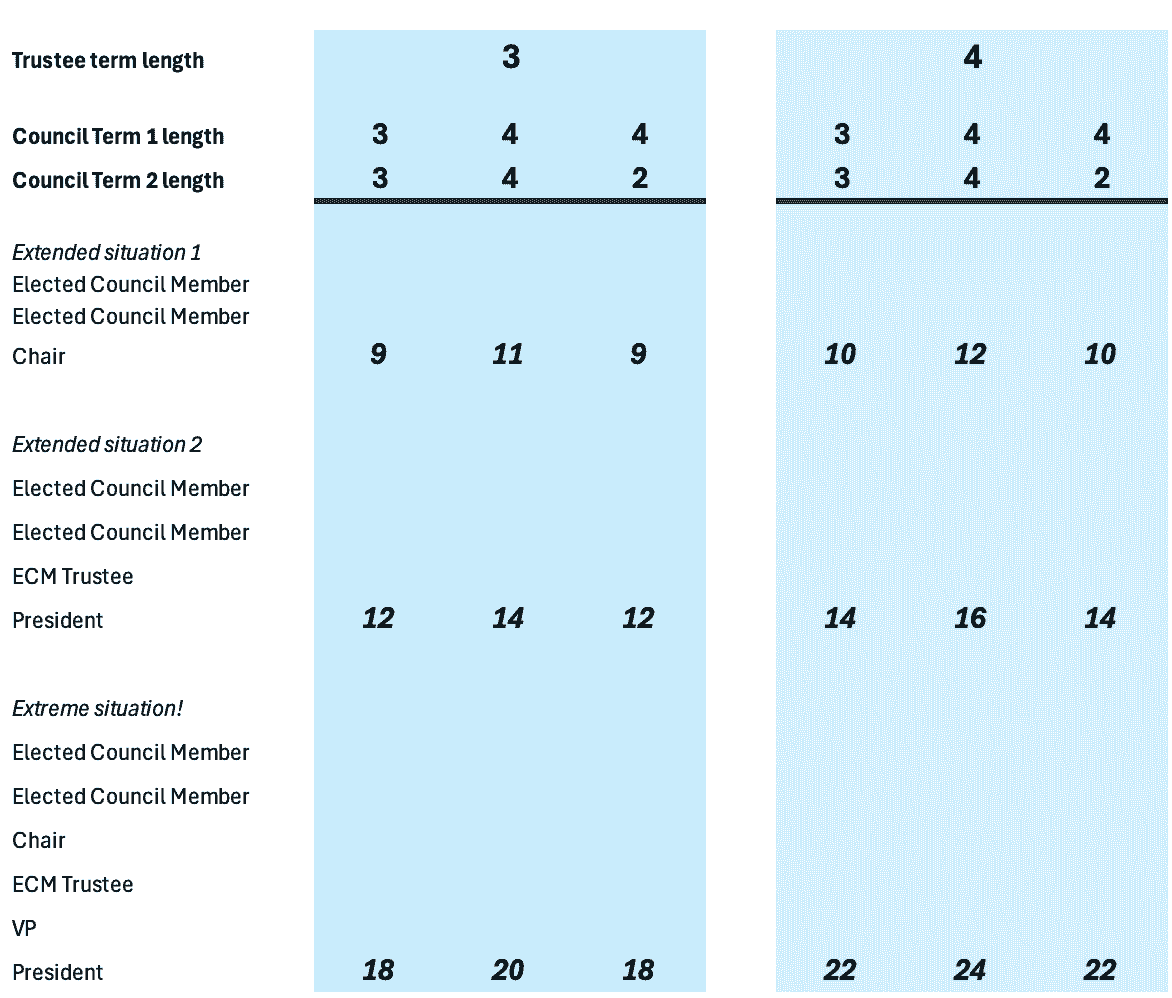
Some worked examples
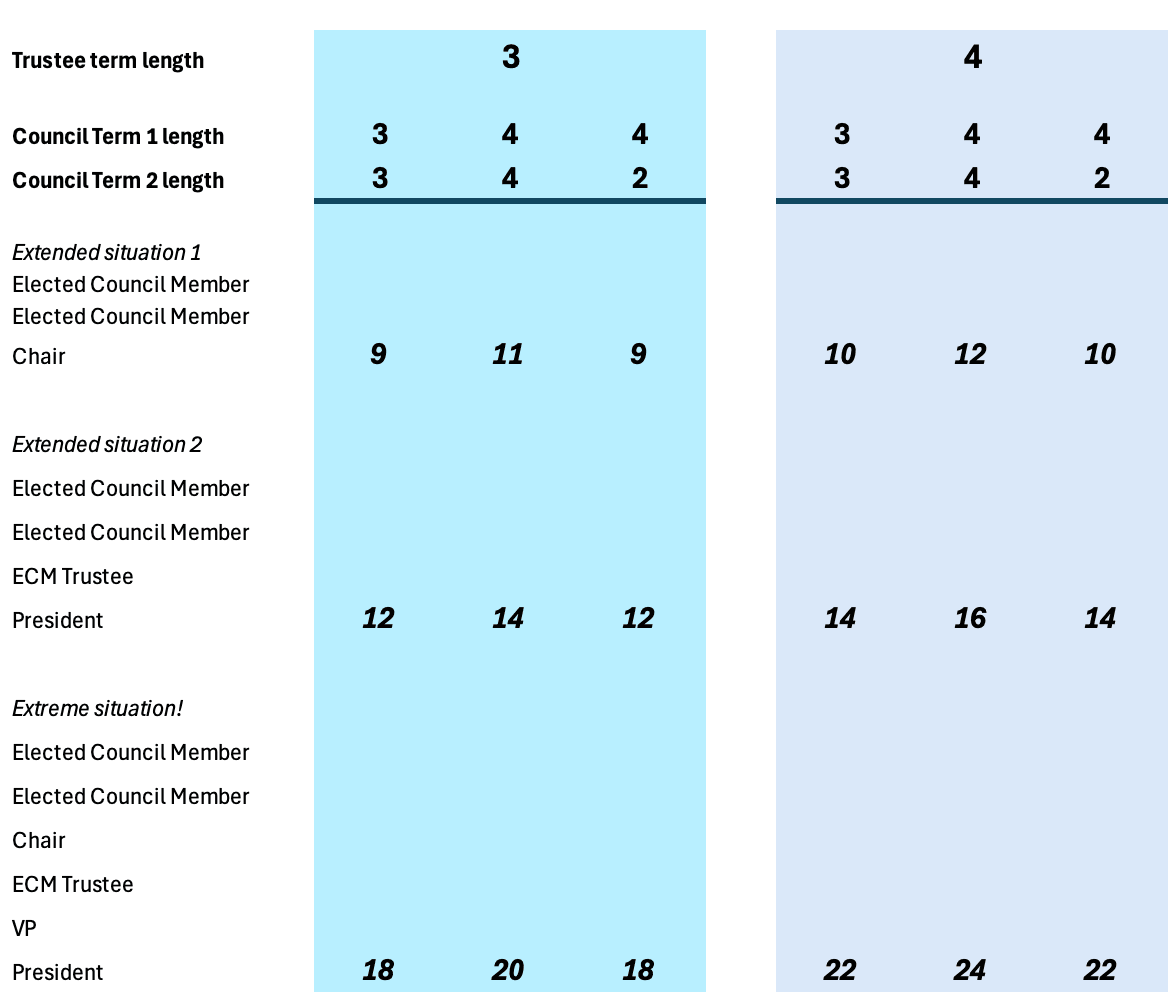
The picture on the left is a screenshot of a spreadsheet in which I've worked out how long people could stick around for by moving from one role to another without needing the year's break, with various combinations of term lengths.
They don't include the possibility of a one year's extension to complete a project at any point, as this would make the table overly complex, and I am confident that you can all add 1 to whatever the totals are.
It's important to remember that Council will be choosing who fills the ECM Trustee, Chair, President and VP positions - so Council can decide not to choose someone, on the grounds that it would make their time on Council without going back to the Membership for a new mandate too long.
All the examples are "worst case", ie standing for the next role in the last year of the person's current term. Obviously, the ones at the bottom of the table are ludicrous, and you'd hope Council would say no, or that the person would just say "enough is enough".
In real life, these "next roles" will come up at varying points in the cycle of people's terms - eg someone's ideal next step might become vacant well before they are about to finish even their first Council term, let alone their second.
Please just let me know if you'd like me to do some examples of more likely shorter extended terms. I've also uploaded the spreadsheet, if you'd like to have a play.
One last point about moving from one role to another
What happens if you are a Trustee, and stand for a different Trustee role before the last year of your current role?This is based on an assumption that all elections will be at roughly the same time of year. It's also based on a suggestion that (for simplicity) you can only apply for one Trustee role at a time.
Example
(I am basing this example on three-year terms for everyone)
You are a Chair (ie ex officio Trustee) and stand for President in your second year.
So if you are successful, your role as President would start at the beginning of what would have been your third year as Chair.
This would create a Chair vacancy - but one which would be unknown until after election season.
So how would you fill it?
I think there are two main options here.
- Have a rule that if you stand for another Trustee role while you're in a Trustee role, your current Trustee role will end even if you're not successful (ie you have to resign from the current post to stand for the next one). This means that your current post can be advertised at the same time as the other roles, and everyone has the same chance to apply for all roles. So if you're a Chair in your second year, and you apply for President but don't get it, your Chair role also ends. You would still be on Council for that last year, but not a Chair any more and not on the Board of Trustees.
- Have a different rule - that if you stand for another Trustee role and you get it, your current Trustee role is then filled with a quick, late election. This would mean that if you don't get the other Trustee role, you can stay in your current one, as it wouldn't have been up for grabs already.
This is one of those things that's not that important, but is very complex. I slightly favour Option 1, even though it seems brutal. This is only because with Option 2, you could get a chain of late elections if more than one role was coming to an end. There's no perfect option: it's really up to you and then ultimately, the FICM Board.
We don't have to decide on Wednesday, but it would be good to talk about it.
UPDATE
A suggestion has come in from the group, which I really like - that if you're a Chair you can only go for P or VP. I hadn't suggested that before, as I was worried that it would look like I thought that a Chair was more senior than an ECM Trustee. To be discussed!
And finally... my reflections from the FICM Board meeting on January 21st
Let me know if you'd like to add anything.
CIKIT
This seems to be causing much more worry than it does in other Colleges, which I think is caused by the current situation in which the Board doesn't have enough power and the Exec has a lot, or seems to.
I think we really need to emphasise that there just needs to be something that isn't a secretive extra layer of governance, but which keeps the engine ticking over between meetings and, if necessary, helps identify a need for an extra Council or Board meeting.
It should be seen in the context of there being more Council meetings, plus new Board of Trustee meetings, plus a Strategy, a business plan and a set of Schemes of Delegation - ie there shouldn't even be that much "incoming" that doesn't fit somewhere else already.
It's also important that we are clear that other impromptu or informal meetings aren't forbidden! - for example, Education and TAQ might want a regular catch-up. Or there might be a temporary working group set up if there's a very significant new government policy, eg Assisted Dying.
CIKIT doesn't have to be in the Articles of Association (the main governing document) nor the Regulations (the secondary governing document). So the new College could be flexible, and trial different ways of working it.
Council
For co-opts, I think I picked up that it would be better to start big and cull later than cause bad blood by removing some roles but not others which are similar. So... Keep keep ICS, ACCP and Pharma?
Term lengths
Varying feedback, seeming to be either three or four years. Someone mentioned five as their ideal number.
Electing or appointing Chairs
Some concern about popularity contests.
I think we could allay this with the ideas we've already talked about, ie candidates have to set out the reasons why they would be good. We can also place a legal duty on Council to elect for the good of the College.
We could also emphasise that there's no perfect way of selecting people for these roles. A Selection Committee might be better able to weed out weaker candidates - but it creates a risk of people thinking it's a shadowy cabal.
My main thought is that there just aren't that enough people in the pool of candidates for there to be real concerns about popularity-only voting. With fewer than 20 elected Council Members (probably), anyone standing for a role should have had a chance to demonstrate their qualities in advance of any elections.
UPDATE - suggestion from the TFG (not from the Board) that a Chair of a main policy could come from the Committee itself, not from elected Council Members. Lots to talk about here.
Elected Council Member Trustees
I think there was a feeling that there didn't have to be as many of these people as the Chairs, so long as there were at least two. Does that resonate with all of you? Are you happy with that? or would prefer that each Chair was "marked" by an ECM Trustee?
Feedback for Meeting 3
Please tell me what you think (or just email me, or call me, or we can fix up a Teams) - especially if you have any preferred options.
Website created by Wellspring Consulting for the CICM.