


Early proposals
Pinning down essentials of the CICM Board and Council
Proposal
the purpose of the Board of Trustees and of Council
The Board of Trustees
- A classic definition of a Board of Trustees is "the body of the College with legal responsibility for the general control, government and management of the administration of the College, its property and affairs." This is based on the definition in the Charities Act, and is what would normally go in the main governing document.
- A more plain-English way to think about this is that the Trustees' responsibility is to further the College's charitable purposes. There will sometimes be a need to approve or challenge something that comes from Council, and it will need to commission and approve the College's strategy. But its main agenda items will be based on holding staff (and others) to account for delivering the College's strategy, money, risk, governance and compliance, reputation, running the College, etc etc. It will also support Council if Council escalates something to the Board for their advice or agreement to resources.
Council
- The purpose of Council should be "to lead on the profession of intensive care medicine" - and please note here that there is nothing in the draft charitable purposes which is not about intensive care medicine, so Council is obviously hugely important.
- In very plain English, we could describe it as "medicine and members"? or "the home of discussions and decisions on intensive care medicine and the clinicians working in it"
- In slightly more formal English, we could say something like "the body of the College focused on the practice of intensive care medicine as a profession, which includes the professional, clinical and educational functions of the College"?
- In formal legal terms, to go in the governing documents, this could be expressed as "Council shall have oversight of all clinical, professional and health policy matters and may exercise such other functions as are delegated to it by the Board of Trustees, subject to any restrictions imposed by the governing documents"
Trustees and Council should not be acting in opposition to each other, fighting for control.
They are both there to deliver the charitable objects, through complementary roles.
Proposal
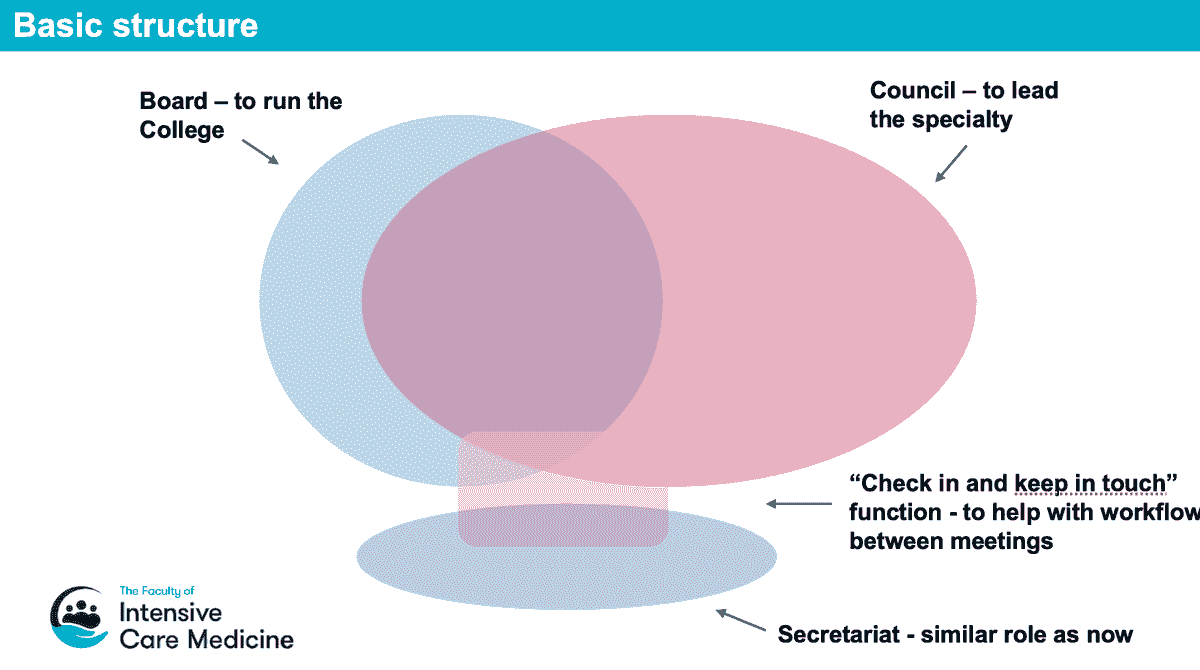
Basic structure and "Check in and keep in touch" function
The diagram below sets out the proposed basic structure.
The next section gives more information on the "Check in and keep in touch" function, which replaces some of what the Exec does now.
- A classic definition of a Board of Trustees is "the body of the College with legal responsibility for the general control, government and management of the administration of the College, its property and affairs." This is based on the definition in the Charities Act, and is what would normally go in the main governing document.

Proposal
the "Check in and keep in touch" function
What is this?
- All Colleges need something which sits between the Board and Council with the aim of maintaining workflow between meetings.
- The "Check in and keep in touch" (CIKIT?) meeting would provide this, and would be the next evolution of the current Exec.
Who would usually attend?
- Mainly staff - Secretariat and links to each main Committee
- President or VP and possibly the Treasurer, or a combination. This could also be a great opportunity to strengthen and clarity the VP role (if needed), and reduce pressure on the President’s time.
Often something that comes into this group will need an opinion from someone else - this could be via an email / phone call / real life chat – they don’t have to attend the whole meeting. The Chairs of the main Committees would not usually attend.
What would it do?
- Decide if something needs a Trustee or Council meeting, and if so, if it can wait or if CICM needs to call one specially
- Triage incoming work not already allocated to a Committee, and pass it back out
- Provide an early sounding board for ideas
- Make decisions - but only if delegated to it, as it is important that it does not accidentally become a mini-version of either the Board of Trustees or Council.
- Prepare a note of actions and make this available to Council and Trustees.
What is it not?
- This group/meeting/function is traditionally vulnerable to being viewed with suspicion by other people in a charity governance hierarchy - it is sometimes seen as a group of VIPs, a clique where "real" power resides, or a mini-Board of Trustees. This can happen even when, as is nearly always the case, there is no such intention within the group.
- The TFG felt that a CIKIT meeting as described above could be a very positive way of making sure that College business carried on between Council and Trustee meetings while maintaining transparency in general, and clarity of roles in particular.
Proposal
the building blocks of terms of office
Why only building blocks?
- Terms of office is a part of governance design which seems easy on the surface, but which can be fiendishly complicated when it comes to multiple terms, moving from one role to another, and roles which might have a longer or shorter term than the majority.
- We will work on this in January and February, but we need a holding position for now to enable other conversations.
The building blocks
- We propose a term of office for Council Members, Trustees and Committee Chairs alike of three years. This is try to balance settling-in time for individuals with maintaining a sensible turnover rate to provide opportunities for other people. There is no one perfect answer here.
- In similar charities, a person is usually eligible to stand for a second term as a Council Member or Trustee. We propose to work on this basis.
- Extensions to terms are usually granted in situations like the following: an elected Member of Council has served for two years and successfully stands to be a Trustee. In that case, they would get a three-year extension to their Council term to enable them to serve a full Trustee term. We propose to work on this basis - establishing limits will be key.
Proposal
the composition of the CICM Council- This should be seen as a starter for ten. For many of these possible Council seats, the TFG did not feel equipped to say a firm yes or no.
- It might be useful to say a few words about voting here. Council votes are usually unanimous or close to unanimous, but it is still important to know who can vote for what. A reasonable place to start is that elected Council Members can vote for anything. However, co-opted/ex officio Members cannot vote on any issue affecting the Membership (eg disciplinary proceedings, changes to membership categories) or in any elections within Council. This will need further thought on the detail.
Elected by
CICM Members
12 consultants (maybe 13 or 14, if Education becomes a Committee equivalent to TAQ, PAS and CRW)
Two resident doctors
One consultant to represent each of Scotland, Wales and Northern Ireland (ie three in total)
One SAS doctor
= 18/19/20 people, all consultants except the Resident and the SAS doctors.
At a later point, we can consider having more or fewer elected Members, depending on decisions about the Board of Trustees and main policy Committees.
Why? to keep the proportion of Council Members who are Trustees to Council Members who are not Trustees sensible - we don't want a situation where only a few elected Council Members are not Trustees, feeling left out - nor a situation where the Board of Trustees does not have a substantial majority of Council Members.
Co-opted or ex officio
Roles where the TFG felt confident with the recommendation
- ACCP (Advanced Critical Care Practitioners)
- PCCS (Paediatric Critical Care Society)
- Lay rep
- Defence
- Chair of LEPU if not filled from the elected Council Members (unless this is deemed to be already covered by TAQ?)
- Chair of Education if this has not been made a main Committee and not filled from elected Council Members
= 6 people
Roles where the TFG thought further discussion was definitely needed
- NCCG (National Critical Care Group - the national representative body for doctors in training in Intensive Care Medicine) - to complement the elected Resident Doctors
- President of the ICS
- Chair of SSUAG if this is not filled through elected Council members - but consider that they already feed in through another Committee
= 3 people
No or Not Yet
- National Clinical Director for Critical and Perioperative Care - because this is England only, and because they will not be needed or be able to contribute to most items of most meetings.
- Critical Care Pharmacy - although the current representative is a great contributor, there are not enough pharmacist members to justify a place on Council
- CCLF (role insufficiently clear at the moment - needs further discussion)
- Overseas rep (not enough overseas members at the moment)
- Nurses (not enough nurse members at the moment)
- RACs (no desire from the group to make this a specific category - and of course, they are eligible to stand for the elected Council Member roles)
- Chair of FFICM - because they will feed in via TAQ
- Lead RA - because they also feed in via another route
Proposal
the composition of the CICM Board of Trustees
- This is split into two halves.
- The first half covers those roles where there is a firm proposal, and the TFG was unanimous. The second half covers roles where more discussion is likely to be needed, and where there were different views.
- Please note that there is no Charity Commission or Charity Governance Code requirement for the Board to be any particular size: this is up to you.

Unanimous proposal, covering half the Board - which lines up with current thinking
The President and Vice-President
(noting that the VP should not automatically become the President). These would be people elected to Council by the College's Members, and then chosen for these roles by Council.
Council will have a duty placed on it to make this choice in the best interests of the College.
Lay Trustees
Three Lay Trustees have already been appointed: Treasurer, Governance and Legal, and Communications.
In future, the Board will appoint the Lay Trustees, following a rigorous process with support from professional charity recruiters,
and in accordance with guidance set out by the Charity Commission and the Charity Governance Code.
"Specific skill, specific time-period" Trustees
(Co-opts )
There will be a power for the Board to co-opt/recruit up to three Trustees to fill a specific need for a specific time if this was not met by the current Trustees.
This is only a power, not a requirement.

Proposal where opinion was divided - for the other half
The preferred proposal here is as follows.
Three or four Trustees who are elected Council Members, elected to the Board by elected Council MembersAND
Four Trustees who are the Chairs of the Committees which deliver the charitable purposes (CRW, TAQ, PAS and probably Education),
- who have been elected to Council by the Membership
- and who are then elected to these Chair and also to the Board by elected Council Members
- ie ex officio Trustees
Chairs would elected by elected Council Members after an open advert to all elected Council Members, setting out the skills and experience required. Candidates will be required to provide a statement explaining how they meet these requirements. This will be made available to elected Members of Council, who will then vote. This could be on an STV basis, and would be online, not at a meeting. Council will be required, by its Terms of Reference, to vote in the best interests of the College and not on a popularity basis.
This is the option which most of the TFG supports, and which Chris Willis Pickup (from Mishcon de Reya) and I recommend. Very simply, we think that this would help to ensure good communication and accountability between the Board and the "engines" which deliver the charitable purposes of the College, ie the three/four main Committees. It is also simpler and easier to manage terms of office in this situation, and it would mean that there was a clear line between people who are Trustees and people who are not Trustees.
Our reasons are set out in detail below, after the description of the secondary proposal.
There is also a secondary proposal to consider
If the FICM Board does not wish Chairs of the main Committees to be elected by Council, it is harder to justify these roles being
ex officio Trustees.
In this case, the proposal would be that the Chairs are not on the Board and that instead, the "other half" of the Board is composed simply of:four to six people who have already been elected to Council, and then successfully stand for Trustee positions, elected by the elected Council Members.
Reasons for this secondary proposal
The view of some members of the TFG is that this would be more democratic, and would offer opportunities to more Council Members, spreading the workload more evenly and bringing different skills to the Board. It would also remove the risk of losing a good candidate because they did not want to be a Trustee and a Chair.
There are risks, and resources requirements associated with the secondary proposal - please let me know if you would to have this detail.
Reasons for the Chairs of the main Committees being ex officio Trustees
These reasons are provided by Chris Willis Pickup and Lucy Devine
Reason 1 - for good governance, the Chairs should be at BoT meetings and engaged with the BoT
Our view is that the best way to make this happen is that the Committee Chairs attend BOT meetings and engage in discussions as part of the Board of Trustees. This would mean the Committee Chairs being there for all the cross-cutting elements of the Board's work, rather than stepping in and out when their Committees are reporting back to the Board.
lt would be very odd if Committee Chairs weren't at the BoT at all, and we think it will be less effective if they were just parachuted in for one agenda item to give a short presentation and then asked to leave.
This is to ensure that the design of CICM's governance supports a close connection between the Board's wider agenda and the College's charitable work delivered through the Committees.
Reason 2 - this will bring clarity and minimise risk of liability
Given the need for Committee Chairs to be present and involved at the Board of Trustees, the question is whether they should be Trustees or only non-voting observers.
We think that, in practice, it would be hard to ensure that their influence is kept at the level of observers only, so we think the most straightforward option is to make them Trustees ex officio.
This is partly to ensure that there is a manageable number of people in the room, partly to ensure that those participating are doing so on a clear and equal footing, and partly to mitigate the risk of Chairs inadvertently taking on liability as 'shadow' or 'de facto' trustees/directors.
Reason 3 - these roles are not "tap on the shoulder" any more
We understand and sympathise with the concerns about how a person was previously made a Chair, but that is a separate point, and one where there is already a corresponding agreement to move to a more democratic way of choosing Chairs.
Reason 4: the idea that this is a short-cut to the Board does not align with the role of a Trustee
We also understand and sympathise with the concern that this might feel like a free ticket to the Board.
Our response here is that membership of the Board should not be seen as the most desirable destination in CICM, to which short-cuts are available only for special people.
Being on the Board is about hard work and giving back to the College, and taking responsibility for its mission and activities.
Reason 5: in most cases, we do not think Trusteeship puts people off Chair roles
We also understand and sympathise with the mirror image of the previous concern, that some people who would be good Committee Chairs might not want to be Trustees and therefore might not apply.
We acknowledge the possibility of losing good candidates because they do not wish to be Trustees, but we are not aware that this is a widespread problem in medical colleges. Nearly all medical college systems of governance include some level of ex officio positions on the Board of Trustees as a result of Council roles, although there is no consistent pattern.
There may be some misunderstanding about the responsibilities and liabilities of the Trustee role, which could and should be addressed in the recruitment process for Chairs (and, indeed, other roles).
Reason 6: this option would not create a situation in which more than half of Council were Trustees
We agree that there should be enough elected Members of Council to ensure that those who are also Trustees are not a majority of Council.
This would be achieved if - as we have discussed already - the new structure included more elected Members of Council, to cover the devolved nations and whatever cohorts (eg SAS doctors) the FICM Board thought was appropriate to see represented on Council.
Reason 7 - this option would enable clearer lines of accountability
Our final point is more pragmatic. It is standard for Committees in charities (including medical colleges) to include at least one
trustee, and it is part of the role of Committee Chairs, under the Charity Governance Code to ensure effective communication between Committees and Boards.Putting these two practices together, it is therefore also usual for key Committees to be chaired by Trustees (with non-Trustee chairs more common for Investment and Audit & Risk committees).
It is simple and clean if a Trustee is also the Chair: if not, the lines of accountability are likely to get confusing – for example, it may mean that the Chair of a Committee attends a Board of Trustees meeting for one item to present their Committee's work, but the Board to whom they are presenting includes a Trustee who is a member (but not Chair) of the same Committee.
Proposal
The CICM President and the Chair of the CICM Board of Trustees should be the same person
This is the unanimous view of the TFG. Chris and Lucy also support this proposal. We have set out the reasons in detail below.
Reason 1: as representative of the College, this person should be an intensive care doctor
We think that it is right for the Chair of the Trustees to be an intensive care doctor. They will sometimes be the face or voice of the College for extremely important issues, for example if there were a legal or regulatory issue, or if there is a controversial decision around spending, eg buying or selling property, updating member fees, etc.
More benignly, theirs will be the signature on the Trustees' Annual Report and financial statements, and the Chair is the person who would lead on presenting the Trustees' Annual Report at the AGM and chairing the whole meeting.
The decision has already been made that the Treasurer will not be an intensive care doctor, and our view is that it would be strange if this was also the case for the Chair of Trustees.
Having the Chair as an intensivist, supported by and balanced with a lay Treasurer, feels like the right balance rather than two lay people at the top of the new College.
Reason 2 - a Lay Chair will not solve the problem of an autocratic, weak or not-neutral President
There may be a concern about the President being autocratic, or not strong enough (particularly if the CEO is not performing well), or not being neutral. If this is the case, the problem would be magnified if they hold both roles.
Our view here is that the remedy for this situation lies in the Trustees' legal duty to act collectively in the best interests of the College. This duty applies to the President in their trustee role, but the other Trustees should also act if they feel that the President is exercising more power than he or she is entitled to, and they should also act if they feel that the President is not acting in the best interests of the College, eg favouring a view or course of action that creates a conflict of interest or loyalty. It shouldn't be left to one person, the Lay Chair, to deal with the problem.
While we acknowledge this concern, we do not think – on reflection – that designing a governance structure with a Lay Chair to guard against the risk of a President "going rogue" is the right solution to the risk. There is no guarantee that that Lay Chair will be able to stand up to the President - and moreover, there is no guarantee that the Lay Chair, or the relationship between the Lay Chair and President, will not be the cause of a power dynamic problem in the first place.
There are other ways to put guardrails around the President role, including how the functions and powers of the role are defined in the College's governing documents and the role description (particularly as compared with other possible roles, such as Vice President, Treasurer, Committee Chairs), as well as training.
Please note that this is not intended to imply that the Trustees should just leave a "rogue President" in place - quite the reverse. A proposal covered next is that the Trustees would have the power to remove one of their own, and in a situation this serious, we would expect that they would consider this. (They might want to take legal advice, as it would be a big step. Usually, just the suggestion is enough to be a catalyst for better behaviour).
Reason 3 - a Lay Chair is also not the best solution to the workload problem
We acknowledge the possible workload issue, but this is not an unusual situation for a President of a medical college, and we think the people standing for this role will be aware of what is expected, particularly if this is made clear in the role specification.
And the important thing is that the new CICM Board and Council work together to share the tasks, supported by the staff available to CICM, not letting everything fall to the President. Spreading the workload in this way should also help with mitigating the risk of the President exercising too much authority, as they will be operating within a structure and team.
Reason 4 - the skills required for both roles are not that different
We also note your concern that Council will focus on the profession and the speciality, and that the Trustees will need a wider focus, covering the speciality and also including finance, risk, compliance, and so on.
However, a Chair does not need to be an expert in the subject matter of the discussion: they simply need to make sure that they have absorbed the papers, asking questions in advance where necessary, and can lead the meeting with authority.
The skills for chairing a Trustee meeting will be very similar to those required for chairing Council: the ability to manage more vocal people's contributions, check that quieter people are being heard, summarise discussions at various points and then bring the conversation to a conclusion.
There is a wealth of training opportunities for Trustees and also for the Chair role: they are not expected to arrive with all the skills they need on day one.
Reason 5: benefit to the NHS
Developing people's skills within the NHS is also a positive reason. We usually find that people say they learn and develop a huge amount in leadership roles in College governance, and if the Chair of Trustees is a doctor, the skills they learn will benefit the NHS during and after their tenure.
We appreciate that people sometimes retire after serving in this role, but this is not always the case.
Reason 6: this is an opportunity for simplicity in what will be a newly complex environment
For the final reason, some context first. Of 18 Royal Medical Colleges that we have looked at over the last few days, 13 have the same person in these two roles. Of the five that don't, one is the Royal College of Physicians of London. As you are all aware, the RCPL has gone through a huge governance upheaval over the last few years, including criticism that the Board of Trustees was not sufficiently close to the membership. One of the others is the Royal College of GPs, whose tripartite model we would definitely not recommend to you (they have a Chair of Council, President AND Chair of Trustees).
We are not assuming that "common" is necessarily equivalent to "right" but CICM will be a brand new College and charitable legal entity, and this change will be challenging enough on its own. Deciding who should Chair the Trustees is a decision where you can avoid complexity and choose to keep things simple for the next few years while you settle in, and follow a tried and tested method that works for the majority of Royal Medical Colleges.
Proposals
How the Board of Trustees manages itself
Can the Board of Trustees remove one of their own number?
It is now unusual if the Trustees do not have power to remove a Trustee.
The TFG recommends that this power is provided for CICM. This sits alongside a standard list of reasons why a term will automatically end (eg bankruptcy, conviction of certain offences, disqualification as a charity trustee).The wording that gives the Trustees power to remove a Trustee is usually in the list of reasons why a term will end, and here is an example:
".....removed by a resolution of the Board of Trustees that it is in the best interests of the College that their office is vacated, passed at a meeting of Board of Trustees"
and then,
"Any such resolution must not be passed unless the Trustee:-
has been given at least 14 Clear Days' notice in writing of the meeting at which the resolution will be proposed and the reasons why it will be proposed; and
has been given a reasonable opportunity to make representations to the meeting either in person or in writing. The Board of Trustees must consider any representations made by the Trustee (or their representative) and thereafter the President, or if the Trustee is the President, a Vice President, must inform the Trustee of the decision following such consideration."
Those last two bullet points are known as "principles of natural justice" for short.
What should the quorum be for the Board of Trustees?
The quorum for a Board of Trustees meeting is the minimum number of unconflicted trustees required to be present in order for decisions to be validly taken.To be clear - it is not a goal! Trustees should attend meetings: the quorum is only a safety net.
The recommendation is based on balancing the following two things:
- what is the minimum number of Trustees that feels acceptable for with making decisions?
- what is the maximum number of Trustees that doesn't make it too hard to be quorate?
Our recommendation is a nice straightforward (and tried and tested!) model:
"50% of the Trustees, which must include at least one person from each of the following two categories:
- the President and the Vice-President
- the Lay Trustees"
Please note that a Trustee with a conflict cannot be considered part of the quorum for that agenda item. This can sometimes require the Secretariat to be alert, and to keep counting throughout a meeting.
What constitutes a majority for a Trustee resolution?
This is usually very simple, just "anything over 50% of the Trustees who are entitled to vote" (ie Trustees who are not conflicted). We propose to adopt the standard model.It is absolutely standard for the Chair of the meeting to have a casting vote. In practice, this is very rarely used (and I have literally never seen it happen myself): most Chairs will work very hard to achieve a majority rather than using their casting vote.
We do not recommend giving anyone (or any group within the Board) a veto - this would give them too much power.
Feedback
Thank you for reading right to the end. Please feel warmly welcome to give feedback on anything presented here - and remember that it might be easier to have a conversation. You can email me on Lucy@wellspringconsulting.co.uk and message or call me on 07931582594.
Website created by Wellspring Consulting for the CICM.


