

Decision Area 2:
Terms of office
The decisions are grouped in two sections below:
- Decisions that are LESS likely to need substantial discussion and,
- Decisions that are HIGHLY likely to need substantial discussion
(Reminder: important doesn't necessarily mean hard/needing a lot of discussion, and easy doesn't necessarily mean unimportant)
At the end of this page, just like the one on Trustees: Who are they? there is a link to a feedback form. This link will take you to a Googledoc where you can add your feedback on all the questions and decisions.
Once you have reviewed this decision area, please move onto Decision area 3.
There is a link for Decision Area 3 at the bottom of the page.
1. Decisions that are LESS likely to need substantial discussion
(Not necessarily less important)
Click on the orange bars to reveal the detail.
How long is a Trustee term? And how many terms can someone serve in a row?
Context
This sounds like "how long is a piece of string?" but actually, there are only a couple of options that Colleges usually use.
Also:
- The Lay Trustees have already been recruited on the basis of a three-year term.
- Any co-opted Trustee will only be there for a specific reason for as specific time - agreed by the Trustees. So that's not relevant here.
So this leaves the President, VP and the Chairs, ie the ex officio Trustees, as one group to think about. And then also - if you decide that you would like to propose this - the three more elected Members of Council, and anyone representating a cohort in the Membership.
Basic proposal about terms of office for elected Members of Council, whether or not they are Trustees
Most of the Trustees will only be Trustees because of their role on Council, so although our first meeting is focusing on Trustees, we need to think about Council for a while.
I think that we should try to keep this as simple as possible.
So I recommend that the basic setting for an elected Member of Council is one term of three or four years, after which the person can stand again for another term. At the end of that second term, they have to have a year's break before they can start another term. (We will discuss "In training" terms of office in our January meeting, which will be all about Council)
Basic proposal about terms of office for the Chair, President and VP roles.
- For the Chairs, the most straightforward option would be to make a term of office as Chair the same as the length of time for which someone would be elected to Council as a "normal" elected Member of Council
However...
- The President and Vice-President will be more difficult. So they are in the "Difficult" area.
- We also need to think about extensions to apply if someone successfully stands for a Chair, P or VP role without having enough time left on their clock to do a full Chair, VP or P role. This will also be in the "Difficult" area. And similarly for the three more elected Members of Council, and anyone representating a cohort in the Membership, if you agree to propose these to the Board.
Are you happy with this - except for the "Difficult" bits, of course? (you can tell me via the feedback form at the end)
Three or four years?
To decide whether it's three or four years, you might as well toss a coin.
- Four years really gives time to settle in and do a great job - but then, if you grant extensions to people who successfully stand for P, VP or Chair, you end up with the possibility that occasionally, a few people will be able to stay on Council and the Board of Trustees for ages.
- Three years doesn't give quite that much time in the role, obviously - but they make it easier to contemplate a series of extensions, as the total time served would (equally obviously!) be a multiple of 3 rather than 4.
I will put this in the "Difficult" area as well, as I think we should discuss it, and have a solid proposal ready to go to the FICM Board. Otherwise, it will take up time at a FICM Board meeting that we really need the Board to use for more important decisions.
How long should the President and Vice-President's terms be?
This is going to require discussion, and so it's in the "Difficult" area.
Is there a lifetime maximum that anyone can serve?
I recommend not. I think that you either have a break OR a lifetime maximum, but not both. People might well be in clinical practice for three or four decades - they may have a lot to offer at the beginning of this time, and a different "lot to offer" towards the end of their career. All in all, this could be quite a lot of years - but separated by a long period in which others could serve.
It would be a shame to have a rule which prevented this.
Are you happy with this? (you can tell me via the feedback form at the end)
What about oddly short times served in office?
There are two main ways in which this could happen.
- Someone resigns (an deliberate resignation or a passive one by being absent or ill), cutting their term short
- Someone stands in to cover a role for a period of time, because someone else has left a role early
I recommend keeping this simple, even though there will occasionally be times when the rules might seem harsh.
Recommendation
- In the first case, the shortened term of the person who finishes early is considered be "a term" - ie they don't get to keep the "unused" years in reserve.
- In the second case, the time spent standing in does not count at all. When the standing in period is finished, the clock goes back to zero. This is because otherwise it will be hard to get people to take on this role - and also, it's not usually as fulfilling to do a role like this for a short time rather than the normal period. So we need to remove disincentives.
Are you happy with this? (you can tell me via the feedback form at the end)
How does a Trustee’s term end “before it should have done”?
Although this will feel difficult and painful when it happens, most of the rules governing this situation are actually quite straightforward.
There is standard legal text for the following reasons for a Trustee's period of office to be terminated early, as follows:
- Bankruptcy,
- Disqualification by a regulator (as a trustee by the Charity Commission or OSCR, as a Director by the Department for Business and Trade),
- Removed from a medical register,
- Being too unwell to discharge their responsibilities as a Trustee (this is extremely rare - it would be decided by a separate registered medical practitioner, not the Board of Trustees)
- Missing a certain number of meetings in a certain period of time AND the Trustees also resolve that the term should end. This gives the Trustees some flexibility for unusual circumstances, eg a transport problem that was not the Trustee's fault
- Removed by a Member vote at an AGM or EGM (this is a statutory right!),
- For the ex officio Trustees, no longer holding the role that created their Trustee status (if you have already agreed this in our earlier discussions),
- For the ex officio Trustees, no longer being a Member of the College,
- And obviously, resignation or death.
There is another reason - that the Trustees themselves remove one of their number. This will need discussion, so it is in the "Difficult" area.
Are you happy with this? (you can tell me via the feedback form at the end)
What should be the term lengths for the first group of Trustees?
The first ex officio CICM Trustees will be the people in the President, VP (ie Dean and Vice Dean) and Chair of main Committee roles on the FICM Board at the time that the CICM Board starts. Starting everyone again at zero years in office is one option. However, that would mean that in a few years' time, everyone's term would end at once, which would be very destabilising.
What normally happens in these situations is that for this first group of people, we stagger their terms of office so that there is a gradual rolling off of the existing people and replacement with new people. This is usually guided by the time people have already served in the legacy organisation (ie FICM). However, this does not have to be a hard and fast rule.
Recommendation
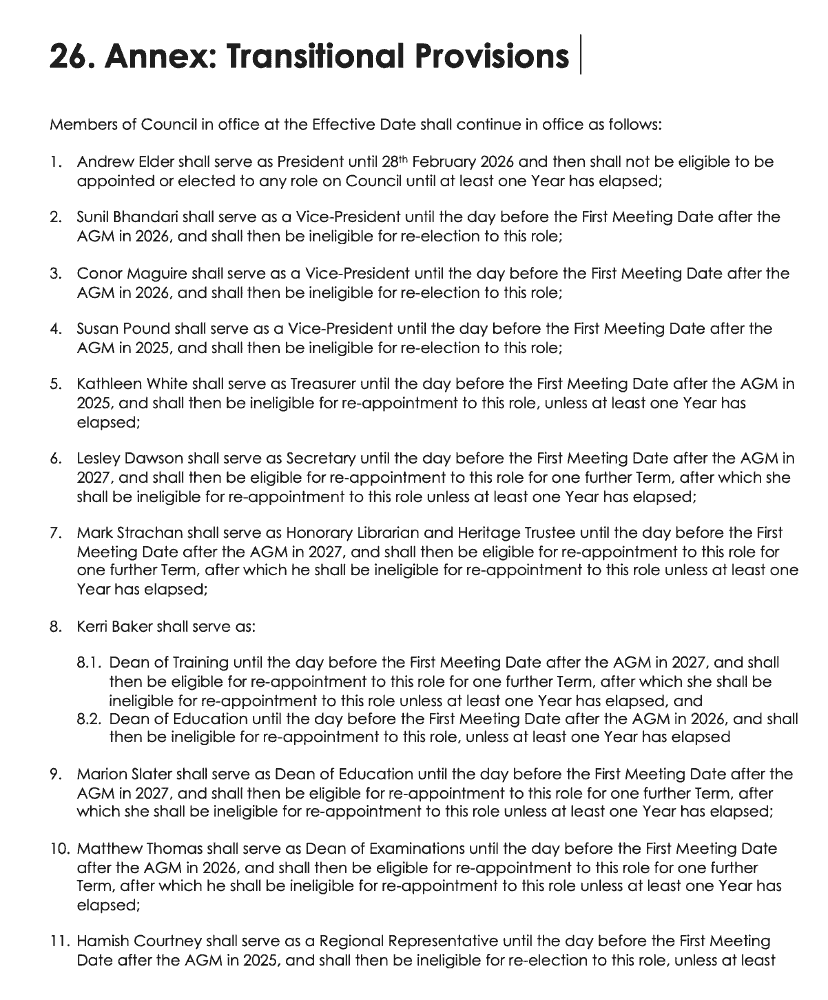
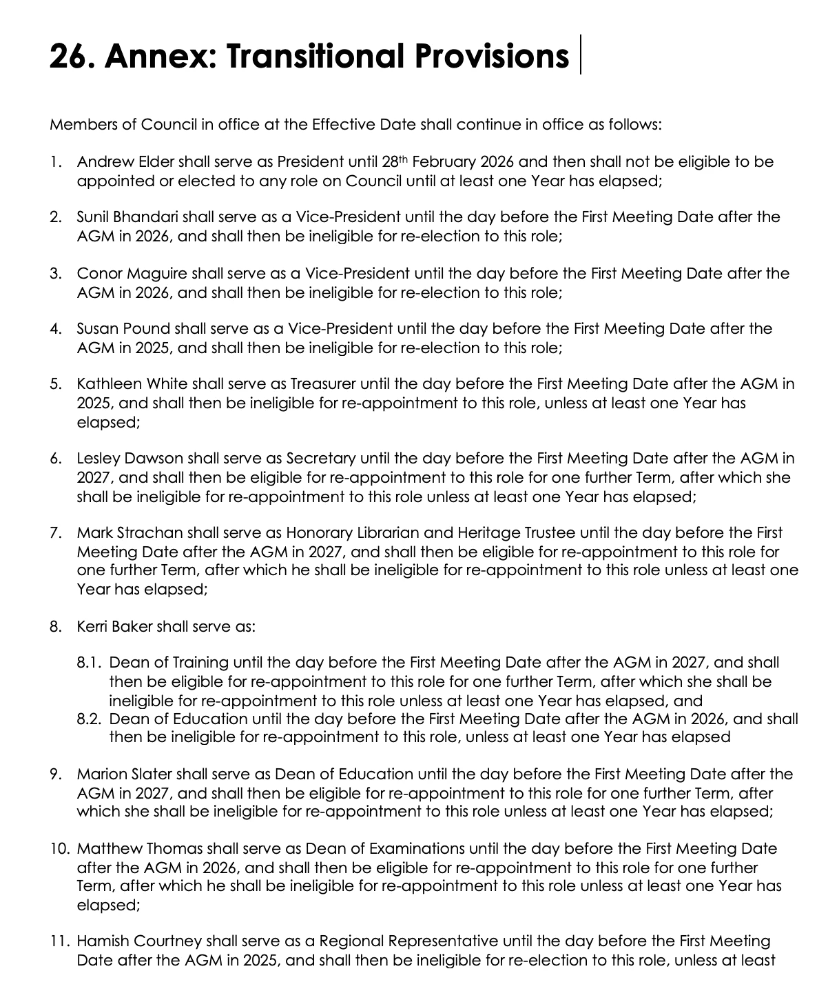
I could provide a first draft of what's called a Transition Schedule or Transitional Provisions - this is a list of suggested first terms of the first Trustees, and whether or not they can stand for another term.
Below, you can see a screenshot of how this worked for the Royal College of Physicians of Edinburgh last year.
Are you happy with this? (you can tell me via the feedback form at the end)
Term lengths for the first group of Trustees - example Transitional Provisions from the RCPE last year ( the first of THREE pages!)
2. Decisions that are MORE likely to need substantial discussion
(Not necessarily more important!)
Click on the orange bars to reveal the detail.
Basic setting for an elected Member of Council term and a Chair term - Three or four years?
In terms of good governance, this is very finely balanced. It's really just a question of what you want.
As noted earlier:
- Four years really gives time to settle in and do a great job - but then, if you grant extensions to people who successfully stand for P, VP or Chair, you end up with the possibility that occasionally, a few people will be able to stay on Council and the Board of Trustees for ages.
- Three years doesn't give quite that much time in the role, obviously - but it's then easier to contemplate a series of extensions, as the total time served would (equally obviously!) be a multiple of 3 rather than 4.
My recommendation would be to go for three years, for two main reasons and one minor one.
- (Main) Two terms of three years is a good solid time to get things done
- (Main) Getting extra time to move from one role to one with more responsibility is a well-established concept in governance. It enables someone to give more to a charity, and ensures that there is a pool of experienced people for these roles. Three years rather than four reduces the chances of someone serially hopping from role to role and sticking around for too long!
- (minor) This is already the agreed term for Lay Trustees.
Early feedback from the FICM Exec has not been strong either way.
We can come to a decision on the 21st - but please do give any feedback before then, if you can
How long should the President and Vice-President's terms be?
I think that your current process is that a President or Vice-President can do three years, but they have to stand again each year.
My recommendation is that three years is a very sensible choice.
I do have a suggestion for change. I think it would more stable and less disruptive if the President and Vice-President did not have to be re-elected each year. We can build in a power for the Trustees or Council to remove the Presidency / Vice-Presidency from someone at any time if there is poor performance, so you wouldn't be stuck with the same person for three years. The advantages and disadvantages are as follows:
Move away from yearly elections
Advantage: more stable, less stressful for the person in post. And the Trustees/Council could remove someone at any time.
Disadvantage: if you did want to replace a President/VP, someone would have to the first mover in making this happen, which would be awkward. Although probably, if the situation was that bad, there would already be some group awareness of this.
Stay as you are
Advantage: if there is a problem with a President / VP, all you have to do is wait until the annual elections and identify a more popular candidate to stand against
Disadvantage: disruptive, stressful for the person in the role, and if there is sa performance issue, you'd probably have to wait for election time to do anything about it.
Early feedback from the FICM Exec is supportive of moving away from yearly elections, but one member of the Exec feels that yearly elections are important for democracy.
We can come to a decision on the 21st - but please do give any feedback before then, if you can
What extensions should there be for if someone successfully stands for P, VP or Chair or elected Member of Council Trustee?
This is one of those topics which is not actually that important (overstayers are not that common!) but causes a lot of heat.
Unless this group rules against this idea, we are likely to suggest to the FICM Board that an individual can serve for two terms on Council, and then has to take a break of a year. If this is the case, it is normal to allow exceptions if someone is chosen for a role with more responsibility, eg Chair, other Trustee role, or VP, or President. Otherwise the College would lose experienced people because they were forced to take the year's break.
However, we do need some safeguards to stop people serially jumping to different named roles, in order to stay on Council for decades.
We need to balance retaining expertise with bringing on fresh talent - this is always a challenge in any organisation. You are not alone!
I suggest that extensions are allowed only if the new role is one of increased responsibility, in this order:
- Elected Member of Council to Chair or Elected Member of Council Trustee or Trustee representating a cohort
- Chair / Elected Member of Council Trustee / Representing a cohort Trustee to VP
- VP to President
This would create a theoretical possibility that someone could do two terms as an Elected Member, then a term with more responsibility, then a term as VP and then a term as President, ie 15 years. However, it is Council who elects the VP and the President - so Council can make an informed decision about whether or not the individual's talents are such that they justify that length of time on Council. In reality, it is much more likely that someone will finish one role early to take on the next role, and/or that no-one wants to do 15 years in a row.
Early feedback from the FICM Exec is mixed: perhaps I didn't explain it very well.
We can come to a decision on the 21st - but please do give any feedback before then, if you can
Can the Trustees remove one of their own number?
It is now unusual if the Trustees do not have power to remove one of their number.
I recommend that the CICM Board of Trustees has this power.
The wording that gives this power is usually in the list of reasons why a term will end, and here is an example:
".....removed by a resolution of the Board of Trustees that it is in the best interests of the College that their office is vacated, passed at a meeting of Board of Trustees"
and then,
- "Any such resolution must not be passed unless the Trustee:-
- has been given at least 14 Clear Days' notice in writing of the meeting at which the resolution will be proposed and the reasons why it will be proposed; and
- has been given a reasonable opportunity to make representations to the meeting either in person or in writing. The Board of Trustees must consider any representations made by the Trustee (or their representative) and thereafter the President, or if the Trustee is the President, a Vice President, must inform the Trustee of the decision following such consideration."
Those last two bullet points are known as "principles of natural justice" for short.
What should the required majority be?
The main question is whether or not the majority required is the normal one for Trustee decsions (ie more than half), or more than that. This is totally up to you. I suspect that in this case, every argument has a counter argument! For example, someone might say "It should be two/thirds, because this is really important" and someone else could say "But that means that the Trustee in question only needs a couple of friends on the Board to block the decision".
Here's some of the maths:
- A Board with eight people, minus the Trustee in question leaves seven voters.
So you'd need four for a majority and five for a two/thirds majority. So just two friends could block the removal.
- A Board with nine people, minus the Trustee in question leaves eight voters.
You'd need five for a majority and six for a two/thirds majority - again, just two friends could block the removal.
- A Board with ten people, minus the Trustee in question leaves nine voters.
Again, you'd need five for a majority and six for a two/thirds majority - needing three friends to block the removal.
I am sure you can work out more examples!
On balance, I think I prefer just the normal "over half" majority, on grounds of simplicity and allowing the majority view to prevail.
I didn't ask the Exec about this specifically, but it was mentioned in passing and there is strong support to have the power. One person said they wanted a 2/3 majority.
We can come to a decision on the 21st - but please do give any feedback before then, if you can
Have I forgotten anything difficult?
Please let me know if I have.
Your feedback and questions
Please click or tap the button below to go to the feedback document. This will open as a Googledoc. Within this document, you will be able to type in your own feedback and see other people's feedback as well.
There is a named section for every member of the Task and Finish Group.
Please add your questions and feedback in your section - and only your section!
Thank you.
After sharing your feedback, please now review Decision Area 3 -
Trustee Meetings and Decision-making
Click or tap the button below to go to Decision Area 3.
Website created by Wellspring Consulting for the CICM.